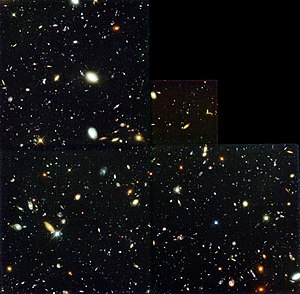
I never realized that the universe is so big. Somehow even though I have learned differently, I assumed that our galaxy was one of a kind and there isn't another one like it. I know that there are billions upon billions of galaxies in the universe, and there is a good possibility that life could exist in any one of those galaxies.
The Hubble Deep Field picture made me realize that even though I might stare at a black spot in the sky and think there can't be anything there, there are actually billions of galaxies in every black or empty spot in the sky. There are different types of galaxies also; ellipticals, spirals, and irregulars. Each of them are unique in their own way.
I learned that you need to have a larger sample size so your measures of central tendency are closer. Astronomers suggest a sample size between 35-45 for best results. Also when you have a larger sample size, your range decreases. I found out that humans are often biased when it comes to picking galaxies and such. Even when we close out eyes and point to one, we are still being biased when we open out eyes and say which our finger is pointing to. It's better to use the computer to select a sample group. The computer is very unbiased and you often get the best results with it. When you use a computer you become much closer to the astronomers results also.
An important thing that I learned it that the number of galaxies (elliptical, spiral, irregular) are near the same in the Hubble Deep Field North and the Hubble Deep Field South. From this we can say that the universe looks the same in these two directions. I think that I learned many things that I didn't know or expect from this activity. I also knew that the universe was big, but I never realized just how big it really is.


No comments:
Post a Comment