Thursday, December 18, 2008
Aliens

The Big Bang
I think that the big bang and the religious side of it can exist together. In the bible it says that God created the earth. That can be true.. the big bang put everything into place and then God evolved everything from that.
Monday, December 15, 2008
Exploring Hubble Deep Field
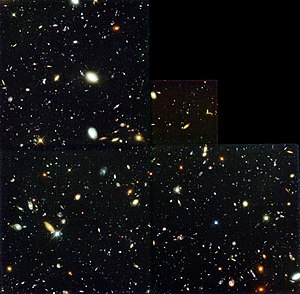
I never realized that the universe is so big. Somehow even though I have learned differently, I assumed that our galaxy was one of a kind and there isn't another one like it. I know that there are billions upon billions of galaxies in the universe, and there is a good possibility that life could exist in any one of those galaxies.
The Hubble Deep Field picture made me realize that even though I might stare at a black spot in the sky and think there can't be anything there, there are actually billions of galaxies in every black or empty spot in the sky. There are different types of galaxies also; ellipticals, spirals, and irregulars. Each of them are unique in their own way.
I learned that you need to have a larger sample size so your measures of central tendency are closer. Astronomers suggest a sample size between 35-45 for best results. Also when you have a larger sample size, your range decreases. I found out that humans are often biased when it comes to picking galaxies and such. Even when we close out eyes and point to one, we are still being biased when we open out eyes and say which our finger is pointing to. It's better to use the computer to select a sample group. The computer is very unbiased and you often get the best results with it. When you use a computer you become much closer to the astronomers results also.
An important thing that I learned it that the number of galaxies (elliptical, spiral, irregular) are near the same in the Hubble Deep Field North and the Hubble Deep Field South. From this we can say that the universe looks the same in these two directions. I think that I learned many things that I didn't know or expect from this activity. I also knew that the universe was big, but I never realized just how big it really is.
Tuesday, December 2, 2008
My Passion
Black Holes
The accretion zone has matter that is just floating around, the event horizon is the place that if matter passes into this it will be sucked in and lost forever.
2. Defines escape velocity, black hole, and the speed of light.
Escape Velocity- The speed needed to break free from a gravitational field.
Black Hole- An area that is so compact that when you get too close, the speed of light isn't fast enough to escape.
Speed of Light- The speed of (2.99793 X 10⁸ m/s, or 186,000 miles/s). It is a constant in empty space.
3. Explains the relationship between escape velocity, black hole, and the speed of light.
The speed of light isn't fast enough to escape a black hole, which is composed of escape velocity.
4. Identifies more than one single type of black hole.
Stellar Black holes- When a massive star super novas.
Super Massive Black holes- At the center of galaxies.
Quasars- When 2 black holes combine and energy is driven off.
5. List evidence that our understanding of black holes has changed.
Astronomers have found convincing evidence for a supermassive black hole in the center of the giant elliptical galaxy M87, as well as in several other galaxies. The discovery is based on velocity measurements of a whirlpool of hot gas orbiting the black hole. In 1994, Hubble Space Telescope data produced an unprecedented measurement of the mass of an unseen object at the center of M87. Based on the kinetic energy of the material whirling about the center (as in Wheeler's dance, see Question 4 above), the object is about 3 billion times the mass of our Sun and appears to be concentrated into a space smaller than our solar system.
For many years x-ray emission from the double-star system Cygnus X-1 convinced many astronomers that the system contains a black hole. With more precise measurements available recently, the evidence for a black hole in Cygnus X-1 is very strong.(site from the blog) It shows that we haven't known everything. The Hubble telescope discovered a lot for us.
A black hole cannot be viewed directly because light cannot escape it. Effects on the matter that surrounds it infer its presence. Matter swirling around a black hole heats up and emits radiation that can be detected. Around a stellar black hole this matter is composed of gas and dust. Around a supermassive black hole in the center of a galaxy the swirling disk is made of not only gas but also stars. An instrument aboard the Hubble Space Telescope, called the Space Telescope Imaging Spectrograph (STIS), was installed in February 1997. STIS is the space telescope's main "black hole hunter." A spectrograph uses prisms or diffraction gratings to split the incoming light into its rainbow pattern. The position and strength of the line in a spectrum gives scientists valuable information. STIS spans ultraviolet, visible, and near-infrared wavelengths. This instrument can take a spectrum of many places at once across the center of a galaxy. Each spectrum tells scientists how fast the stars and gas are swirling at that location. With that information, the central mass that the stars are orbiting can be calculated. The faster the stars go, the more massive the central object must be.(site from blog)
7. List at least 2 myths about black holes that are discredited.
The volume of a black hole approaches zero. As volume decreases, density increases. Density is the relationship of mass per unit of volume (Density = Mass/Volume). The density of a black hole affects the escape velocity of an object — even light.
Black holes have a broad range of masses — from the smallest (miniature) to the largest (supermassive).
Thursday, November 13, 2008
The End of the World...
Space Weather and Asteroids
Most objects that come close to Earth aren't anything that could do damage to us. NASA says that only a relatively small number of the hazardous objects are large enough for us to worry about. They also say that because of the gravitational pull, these objects could come into Earth's path. The closest that an object has been recently was .01LD, but it was only 4m in size. If people are worried about another Tunguska happening, we aren't 100% sure what it was that hit. Most of the asteroids are located in the asteroid belt and that is a ways from Earth. There are only a few that regularly travel by us.
I think that most anything that comes close to us is going to be relatively small and nothing that we should have to worry about. We shouldn't be scared for the time being.
Wednesday, November 12, 2008
Plate Tetconics
Importance of:
1) Pangaea-- Some 225 million years ago all the world's land masses were joined together into one supercontinent, Pangaea, surrounded by a single universal sea, Panthalassa. Through the upheavals that we have since come to know as plate tectonics, the shifting of the Earth's crust tore the supercontinent asunder about the middle of the Mesozoic period (approximately 180 million years B.P.) and large bodies of land drifted across the surface of the Earth to ultimately become our present-day continents.(http://www.pangaea.org/continen.htm)
2) Sea Floor Spreading-- This helps explain continental drift in plate tetonics. Sea-floor spreading is the process in which the ocean floor is extended when two plates move apart. As the plates move apart, the rocks break and form a crack between the plates. Earthquakes occur along the plate boundary. Magma rises through the cracks and seeps out onto the ocean floor like a long, thin, undersea volcano.(http://library.thinkquest.org/17457/platetectonics/4.php)
3) Plate Boundaries-- Plate boundaries are found at the edge of the lithospheric plates and are of three types, convergent, divergent and conservative. Wide zones of deformation are usually characteristic of plate boundaries because of the interaction between two plates. The three boundaries are characterized by their distinct motions. the create tremors that help move plates.(http://scign.jpl.nasa.gov/learn/plate4.htm)
4) Ring of Fire-- In a 40,000 km horseshoe shape, it is associated with a nearly continuous series of oceanic trenches, volcanic arcs, and volcanic belts and/or plate movements. The Ring of Fire has 452 volcanoes and is home to over 75% of the world's active and dormant volcanoes.Ninety percent of the world's earthquakes and 80% of the world's largest earthquakes occur along the Ring of Fire.he Ring of Fire is a direct result and consequence of plate tectonics and the movement and collisions of crustal plates. (http://en.wikipedia.org/wiki/Pacific_Ring_of_Fire)
5) Mid Ocean Ridge-- A mid-ocean ridge or mid-oceanic ridge is an underwater mountainrift running along its axis, formed by plate tectonics. This type of oceanic ridge is characteristic of what is known as an oceanic spreading center. The uplifted sea floor results from convection currents which rise in the mantle as magma at a linear weakness in the oceanic crust, and emerge as lava, creating new crust upon cooling. A mid-ocean ridge demarcates the boundary between two tectonic plates, and consequently is termed a divergent plate boundary.(http://en.wikipedia.org/wiki/Mid-ocean_ridge)
6) A Shifting North and South Pole-- Over the past century the pole has moved 685 miles (1,100 kilometers) from Arctic Canada toward Siberia. The shift is likely a normal oscillation of the Earth's magnetic field, Stoner said, and not the beginning of a flip-flop of the north and south magnetic poles, a phenomenon that last occurred 780,000 years ago.Such reversals have taken place 400 times in the last 330 million years, according to magnetic clues sealed in rocks around the world. Each reversal takes a thousand years or more to complete.(http://news.nationalgeographic.com/news/2005/12/1215_051215_north_pole.html) range, typically having a valley known as a
PART 2
Volcanoes on the Moon and Mars-- It tells us that plate tectonics played a roll in shaping these masses.
PART 3
Motion Rates-- DUBO -- Latitude: -4.26 mm/yr. Longitude: -17.30 mm/yr.
HILO -- Latitude: 35.87 mm/yr. Longitude: -62.83 mm/yr.
KELY -- Latitude: 11.23 mm/yr. Longitude: -17.66 mm/yr.
HOFN -- Latitude: 14.87mm/yr. Longitude: 13.09 mm/yr.
PART 4
-The shift of mass and the massive release of energy very slightly altered the Earth's rotation. The exact amount is not yet known, but theoretical models suggest the earthquake shortened the length of a day by 2.68 microseconds, due to a decrease in the oblateness of the Earth.[22] Because of its enormous energy release and shallow rupture depth, the earthquake generated remarkable seismic ground motions around the globe, particularly due to huge Rayleigh (surface) elastic waves that exceeded 1 cm in vertical amplitude everywhere on Earth. The earthquake was unusually large in geographical extent. An estimated 1,600 km (994 mi) of faultline slipped about 15 m (50 ft) along the subduction zone where the India Plate slides under the Burma Plate. The slip did not happen instantaneously but took place in two phases over a period of several minutes. Seismographic and acoustic data indicate that the first phase involved a rupture about 400 km (250 mi) long and 100 km (60 mi) wide, located 30 km (19 mi) beneath the sea bed—the longest rupture ever known to have been caused by an earthquake.(http://en.wikipedia.org/wiki/2004_Indian_Ocean_earthquake)
-The Indian Ocean is kind of a heart or mitten shape.
PART5
-Alfred Wegener also came up with a theory to explain continental drift, although it was in error. His theory of continental drift proposed that centrifugal force moved the heavy continents toward the equator as the Earth spun. He thought that inertia, from centrifugal movement combined with tidal drag on the continents (caused by the gravitational pull of the sun and moon) would account for continental drift. Browsing the library at the University of Marburg, where he was teaching in 1911, Wegener was struck by the occurrence of identical fossils in geological strata that are now separated by oceans. The accepted explanations or theories at the time posited land bridges to explain the fossil anomalies; animals and plants could have migrated between fixed separate continents by crossing the land bridges. But Wegener was increasingly convinced that the continents themselves had shifted away from a primal single massive supercontinent, which drifted apart about 180 million years ago, to judge from the fossil evidence.[2] Wegener used land features, fossils, and climate as evidence to support his hypothesis of continental drift. Examples of land features such as mountain ranges in Africa and South America lined up; also coal fields on Europe matched up with coal fields in North America. Wegener noticed that fossils from reptiles such as Mesosaurus and Lystrosaurus were found in places that are now separated by oceans. Since neither reptile could have swum great distances, Wegener inferred that these reptiles had once lived on a single landmass that split apart.This would help him be more believed. From 1912 he publicly advocated the theory of "continental drift", arguing that all the continents were once joined together in a single landmass and have drifted apart. In 1915, Wegener published the theory that there had once been a giant supercontinent, which, in later editions, he named "Pangaea" (meaning "All-Lands" or "All-Earth") and drew together evidence from various fields. Expanded editions during the 1920s presented the accumulating evidence. The last edition, just before his untimely death, revealed the significant observation that shallower oceans were geologically younger.

Summary: This video talked about all of the high and low spots on Venus. It gave us the information provided by Russian satellites. It told how it is a twin to Earth. It was very informational.
Size compared to Earth: 12,000 km in diameter (almost as big as Earth)
Distance from the sun: 108,000,000 km
Weight compared to Earth: N/A
Composition: Lava, clouds, dense atmosphere, like hell, high temperatures, brightest planet, rock, highlands, coronie, 96% Co2.
Monday, November 10, 2008
Jupiter's moons lab reflection
Galileo must have had an extremely hard time trying to see the moons of Jupiter because he only had a telescope the was 10x. He probably wasn't able to see what the actual moons looked like or even see the moons at all. We were up to 400x when we could see all moons clearly. Galileo noticed that Jupiter had it's own mini solar system. Because he saw that these moons orbited around Jupiter he determined that our solar system was heliocentric. He decided that because moons could orbit around Jupiter we must orbit around the sun.
Wednesday, November 5, 2008
Tuesday, October 28, 2008


In 1964 Bahcall and Ray Davis Jr of Brookhaven published back-to-back papers in Physical Review Letters that essentially defined what became known as the solar neutrino problem. In the decades that followed Davis consistently measured less than half the flux of solar neutrinos that had been predicted by Bahcall. Either Bahcall's theory or Davis' experiment was wrong, or possibly both, or else neutrinos behaved in unexpected ways.
It turned out that both Bahcall and Davis were right - the electron neutrinos produced by the Sun were oscillating into muon neutrinos that did not show up in Davis' detector. In 2002 Davis and Masatoshi Koshiba of the University of Tokyo shared the Nobel Prize for their work on solar neutrinos. It was widely expected that Bahcall would share a subsequent prize for the discovery of neutrino oscillations.
Sources:http://www.worldbookonline.com/advanced/search?st1=Ray+Davis&x=41&y=13&searchprop=atk
American astrophysicist, shared the 1983 Nobel Prize in physics with William A. Fowler for research on the evolution and death of stars. Chandrasekhar is best known for his work on white dwarf stars—the compact final state in the evolution of certain stars.
Chandrasekhar discovered that white dwarfs with a mass 1.4 times greater than the mass of our sun collapse as a result of their own gravitation. Eventually, they become neutron stars—stars with the density of an atomic nucleus—or collapse even further to become black holes. A black hole is so dense that not even light can escape from its powerful gravitation. The maximum mass a white dwarf star can have before it begins to collapse is known as the Chandrasekhar mass.
Sources:http://www.worldbookonline.com/advanced/article?id=ar105960&st=chandrasekhar

German-born American astrophysicist, discovered and studied cosmic microwave background radiation. In 1978, he won the Nobel Prize for physics, sharing it with his American colleague Robert Wilson
(1936-...)Wilson
American radio astronomer. He shared half of the 1978 Nobel Prize for physics with fellow American Arno Penzias for their discovery and study of cosmic microwave background radiation.
Sources: http://www.worldbookonline.com/advanced/article?id=ar725808&st=robert+wilson

leading American female astronomer of her generation. In 1896, she joined the staff of the Harvard Observatory. Working with other astronomers there, Cannon developed a system of classifying stars by the spectra of their light and applied the system to over 350,000 stars. She discovered 300 variable stars, five novae (types of exploding stars), and a binary star. In 1925, Cannon became the first woman awarded an honorary doctorate of science by Oxford University.
Sources:http://www.worldbookonline.com/advanced/article?id=ar091720&st=annie+cannon
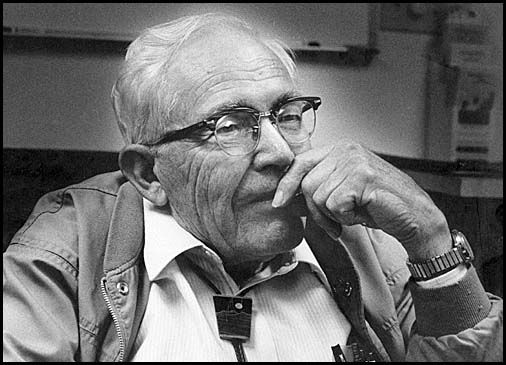
American astronomer. He discovered Pluto, a dwarf planet that orbits far from the sun, in 1930 while he was examining some photographic plates with a blink microscope at the Lowell Observatory. Percival Lowell had predicted the general location of Pluto 15 years earlier. Tombaugh became engaged in ballistics research at White Sands (New Mexico) Missile Range in 1946. He was born in Streator, Illinois.
Sources: http://www.worldbookonline.com/advanced/article?id=ar723410&st=clyde+tombaugh


Some of Einstein's most famous ideas make up parts of his special theory of relativity and his general theory of relativity. For example, the special theory describes an entity known as space-time. This entity is a combination of the dimension of time and the three dimensions of space—length, width, and height. Thus, space-time is four-dimensional. In the general theory, matter and energy distort (change the shape of) space-time; the distortion is experienced as gravity.
Sources:http://nobelprize.org/nobel_prizes/physics/laureates/1921/einstein-bio.html
http://www.worldbookonline.com/advanced/article?id=ar175340&st=albert+einstein

Edwin Hubble (1889-1953) expanded our view of the universe. At the dawn of the 20th century, most astronomers thought that the Milky Way Galaxy was the universe, and it measured only a few thousand light-years across.
Sources: http://www.pbs.org/wnet/hawking/cosmostar/html/cstars_hubble.html

Newton made a huge impact on theoretical astronomy. He defined the laws of motion and universal gravitation which he used to predict precisely the motions of stars, and the planets around the sun. Using his discoveries in optics Newton constructed the first reflecting telescope.
Sources: http://www-groups.dcs.st-and.ac.uk/~history/Mathematicians/Newton.html
http://www.lucidcafe.com/library/95dec/newton.html

Italian scientist who formulated the basic law of falling bodies, which he verified by careful measurements. He constructed a telescope with which he studied lunar craters, and discovered four moons revolving around Jupiter and espoused the Copernican cause.
Without a doubt, Galileo made many important contributions to observational astronomy. Historians disagree, however, about Galileo's role as a founder of modern experimental science. In fact, some of them doubt the importance of experiment in Galileo’s scientific development. These historians maintain that Galileo's real originality lay in the way he approached scientific problems. First, Galileo reduced those problems to very simple terms on the basis of everyday experience and common-sense logic. Then he analyzed and resolved the problems according to simple mathematical descriptions. The success with which Galileo applied this technique to the analysis of physics, especially the physics of motion, opened the way for the development of modern mathematical physics.
Galileo also pioneered the presentation of scientific findings to the widest possible audience. He wrote in clear, witty Italian rather than Latin, the scholarly language of his time. The broad public appeal of his Dialogue most likely contributed to Galileo’s condemnation by the church.
Sources: http://www-groups.dcs.st-and.ac.uk/~history/Mathematicians/Galileo.html
http://www.worldbookonline.com/advanced/article?id=ar215300&st=galileo+galilei

With generous royal support, Tycho constructed there a domicile and observatory which he called Uraniborg, and developed a range of instruments of remarkable size and precision which he used, with the aide of numerous assistants and students, to observe comets, stars, and planets.
Sources: http://www.hps.cam.ac.uk/starry/tycho.html
http://www.hps.cam.ac.uk/starry/tycho.html
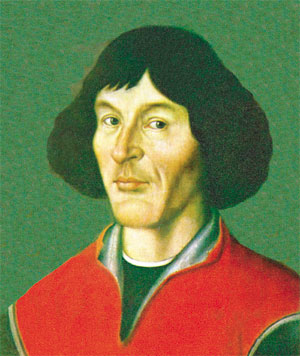
Copernicus is said to be the founder of modern astronomy.
He made his celestial observations from a turret situated on the protective wall around the cathedral, observations were made "bare eyeball," so to speak, as a hundred more years were to pass before the invention of the telescope. In 1530, Copernicus completed and gave to the world his great work De Revolutionibus, which asserted that the earth rotated on its axis once daily and traveled around the sun once yearly: a fantastic concept for the times. Up to the time of Copernicus the thinkers of the western world believed in the Ptolemiac theory that the universe was a closed space bounded by a spherical envelope beyond which there was nothing.
Sources: http://www-groups.dcs.st-and.ac.uk/~history/Mathematicians/Copernicus.html
http://www.blupete.com/Literature/Biographies/Science/Copernicus.htm

Humanity's understanding of the relative brightness and variability of stars was revolutionized by the work of Henrietta Swan Leavitt (1868-1921). Working at Harvard College Observatory, Leavitt precisely calibrated the photographic magnitudes of 47 stars to which all other stars could be compared. Leavitt discovered and cataloged over 1500 variable stars in the nearby Magellanic Clouds. From this catalog, Leavitt discovered that brighter Cepheid variable stars take longer to vary, a fact used today to calibrate the distance scale of our universe.
Sources: http://apod.nasa.gov/apod/ap981027.html
http://apod.nasa.gov/apod/ap981027.html

Van Allen's career took an important turn in 1955 when he and several other American scientists developed proposals for the launch of a scientific satellite as part of the research program conducted during the International Geophysical Year (IGY) of 1957-1958. After the success of the Soviet Union with Sputnik 1, Van Allen's Explorer spacecraft was approved for launch on a Redstone rocket. It flew on 31 January 1958, and returned enormously important scientific data about the radiation belts circling the Earth.
Sources:http://history.nasa.gov/sputnik/vanallen.html
http://history.nasa.gov/sputnik/vanallen.html

Michelson did not see how he had helped physics by shattering the belief of the mysterious "aether." Nevertheless, he calculated one of the most accurate values for the speed of light in 1923. His initial value was 299,798 km/s for the speed of light. His final results were completed in 1933 after his death and were 299,774 km/s which differed from the accepted value of 1970 by only 2 km/s. In 1907, for his work on determining the speed of light, Albert Michelson became the first American to win a Nobel Prize for Physics. Michelson's interferometer had different applications as well. For example, he used a modified version of his interferometer attached to a telescope for making the first successful measurement of a star’s diameter (Betelgeuse) in 1920.
Sources:http://www.aip.org/history/gap/Michelson/Michelson.html
http://www.usd.edu/phys/courses/phys300/gallery/clark/mich.html

He is perhaps best known for creating the Gregorian calendar, which is the calendar still in use in the West today. According to the Julian calendar, the year is 365 days 6 hr, a bit long. By the 16th century all of this accumulated time had moved the vernal equinox to March 11 from March 21. So, in 1582 Gregory simply "deleted" 10 days from the new calendar, which now included "leap days" in order to make up for more accumulated time in the future. By 1585, it had replaced the older Julian calendar in most Catholic countries. Protestant countries adopted it only gradually and some Eastern Orthodox countries did not do so until the 20th century.
Sources: http://www.nndb.com/people/130/000094845/
http://atheism.about.com/library/glossary/western/bldef_gregoryxiii.htm
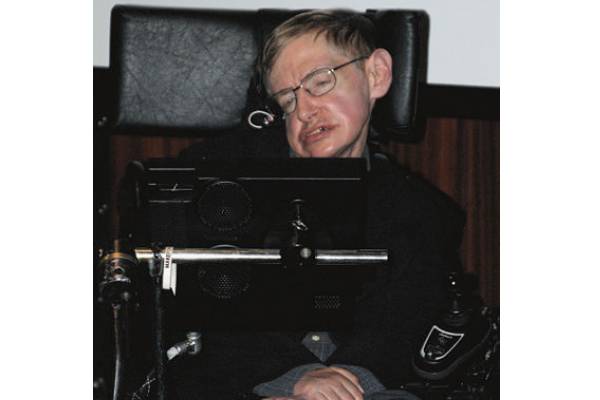
British theoretical physicist. He has made what are regarded as the most important discoveries about gravity since the German-born physicist Albert Einstein invented general relativity, the modern theory of gravity, in 1915. Hawking's work supports the theory that the universe began in a big bang. Hawking is probably best known for his theories about black holes—invisible bodies in space with such strong gravitational force that not even light can escape them (see Black hole). Hawking has used the field of physics called quantum mechanics to show that a black hole nevertheless gives off particles and radiation until it eventually explodes and disappears. He continues to work on combining quantum mechanics and gravity in a single theory that would explain the origin and structure of the universe (see Quantum mechanics). Hawking's books A Brief History of Time: From the Big Bang to Black Holes (1988) and The Universe in a Nutshell (2001) became best sellers.
Sources: http://www.worldbookonline.com/student/article?id=ar248880&st=stephen+hawking

American astronomer, author, and educator. He gained fame as a leading popularizer of science. Sagan wrote several books, numerous magazine articles, and many scientific papers. He was the chief writer and narrator of "Cosmos," a popular public television series. The series dealt with a wide variety of scientific issues. Sagan's writings reflect his broad interests. In his works, he discussed the nature of the planets and their atmospheres, the origin and evolution of life on the earth, and the possibility of life on other planets.
Sources: http://www.imdb.com/name/nm0755981/
http://www.worldbookonline.com/student/article?id=ar481745&st=carl+sagan

He was an astronomer, mathematician and geographer. He codified the Greek geocentric view of the universe, and rationalized the apparent motions of the planets as they were known in his time.
Ptolemy synthesized and extended Hipparchus's system of epicycles and eccentric circles to explain his geocentric theory of the solar system. Ptolemy's system involved at least 80 epicycles to explain the motions of the Sun, the Moon, and the five planets known in his time. He believed the planets and sun to orbit the Earth in the order Mercury, Venus, Sun, Mars, Jupiter, Saturn . This system became known as the Ptolemaic system. It predicts the positions of the planets accurately enough for naked-eye observations This is described in the book Mathematical Syntaxis (widely called the Almagest), a thirteen book mathematical treatment of the phenomena of astronomy. It contains a myriad of information ranging from earth conceptions to sun, moon, and star movement as well as eclipses and a breakdown on the length of months. The Almagest also included a star catalog containing 48 constellations, using the names we still use today.
Sources: http://obs.nineplanets.org/psc/theman.html

Based on Babylonian observations, he improved the accuracy of the length of the lunar, solar and sidereal years. He estimated the solar year with an accuracy which is only 6 1/2 minutes different from the current value. For the lunar month he obtained a value of 29 days, 12 hours, 44 minutes and 2 ½ seconds, only less than 1 second from the current value!
The tropical (solar) year is the period of the Sun's apparent revolution from an equinox to the same equinox again (The time reference that we use in everyday life), and the sidereal year is the period of the Sun's apparent revolution from a fixed star to the same fixed star.
Hipparchus discovered the precession of the equinoxes and was influential in the development of trigonometry, redefined and formalized the projection as a method for solving complex astronomical problems without spherical trigonometry and probably proved its main characteristics.
Hipparchus produced until 129 BC a catalogue of 850 stars after observing 134 BC a new star in the sky. This catalogue was of high precision and used even by the astronomer Edmund Halley. Hipparchus compared his star positions with those of Timocharis and Aristillus. He could not find any stars that had appeared or disappeared in the last 150 years but all the stars seemed to have changed their places with reference to that point in the heavens where the ecliptic is 90° from the poles of the earth i.e. the equinox. He found that this could be explained by a motion of the equinox in the direction of the apparent diurnal motion of the stars. He found the precession of the equinoxes, which takes place at the rate of 52",1 every year due to a steady revolution of the earth's pole round the pole of the ecliptic once in 26000 years in the opposite direction to the planetary revolutions.
Sources:http://www-groups.dcs.st-and.ac.uk/~history/Biographies/Hipparchus.html
http://www.mlahanas.de/Greeks/Hipparchus.htm

His encyclopedic works covered many subjects, including ethics, logic, metaphysics, politics, rhetoric, poetry, biology, zoology, physics, and psychology. His thought greatly influenced philosophers of the Middle Ages (A.D. c. 450–c. 1500) and in some areas of knowledge his ideas are still considered important.
Sources: http://www.philosophypages.com/ph/aris.htm
http://www.enotes.com/history-fact-finder/philosophy/why-aristotle-considered-one-greatest-minds
