Thursday, December 18, 2008
Aliens

The Big Bang
I think that the big bang and the religious side of it can exist together. In the bible it says that God created the earth. That can be true.. the big bang put everything into place and then God evolved everything from that.
Monday, December 15, 2008
Exploring Hubble Deep Field
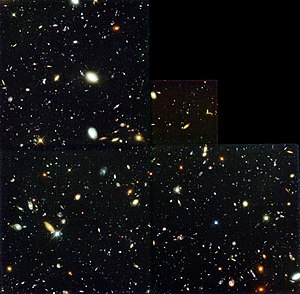
I never realized that the universe is so big. Somehow even though I have learned differently, I assumed that our galaxy was one of a kind and there isn't another one like it. I know that there are billions upon billions of galaxies in the universe, and there is a good possibility that life could exist in any one of those galaxies.
The Hubble Deep Field picture made me realize that even though I might stare at a black spot in the sky and think there can't be anything there, there are actually billions of galaxies in every black or empty spot in the sky. There are different types of galaxies also; ellipticals, spirals, and irregulars. Each of them are unique in their own way.
I learned that you need to have a larger sample size so your measures of central tendency are closer. Astronomers suggest a sample size between 35-45 for best results. Also when you have a larger sample size, your range decreases. I found out that humans are often biased when it comes to picking galaxies and such. Even when we close out eyes and point to one, we are still being biased when we open out eyes and say which our finger is pointing to. It's better to use the computer to select a sample group. The computer is very unbiased and you often get the best results with it. When you use a computer you become much closer to the astronomers results also.
An important thing that I learned it that the number of galaxies (elliptical, spiral, irregular) are near the same in the Hubble Deep Field North and the Hubble Deep Field South. From this we can say that the universe looks the same in these two directions. I think that I learned many things that I didn't know or expect from this activity. I also knew that the universe was big, but I never realized just how big it really is.
Tuesday, December 2, 2008
My Passion
Black Holes
The accretion zone has matter that is just floating around, the event horizon is the place that if matter passes into this it will be sucked in and lost forever.
2. Defines escape velocity, black hole, and the speed of light.
Escape Velocity- The speed needed to break free from a gravitational field.
Black Hole- An area that is so compact that when you get too close, the speed of light isn't fast enough to escape.
Speed of Light- The speed of (2.99793 X 10⁸ m/s, or 186,000 miles/s). It is a constant in empty space.
3. Explains the relationship between escape velocity, black hole, and the speed of light.
The speed of light isn't fast enough to escape a black hole, which is composed of escape velocity.
4. Identifies more than one single type of black hole.
Stellar Black holes- When a massive star super novas.
Super Massive Black holes- At the center of galaxies.
Quasars- When 2 black holes combine and energy is driven off.
5. List evidence that our understanding of black holes has changed.
Astronomers have found convincing evidence for a supermassive black hole in the center of the giant elliptical galaxy M87, as well as in several other galaxies. The discovery is based on velocity measurements of a whirlpool of hot gas orbiting the black hole. In 1994, Hubble Space Telescope data produced an unprecedented measurement of the mass of an unseen object at the center of M87. Based on the kinetic energy of the material whirling about the center (as in Wheeler's dance, see Question 4 above), the object is about 3 billion times the mass of our Sun and appears to be concentrated into a space smaller than our solar system.
For many years x-ray emission from the double-star system Cygnus X-1 convinced many astronomers that the system contains a black hole. With more precise measurements available recently, the evidence for a black hole in Cygnus X-1 is very strong.(site from the blog) It shows that we haven't known everything. The Hubble telescope discovered a lot for us.
A black hole cannot be viewed directly because light cannot escape it. Effects on the matter that surrounds it infer its presence. Matter swirling around a black hole heats up and emits radiation that can be detected. Around a stellar black hole this matter is composed of gas and dust. Around a supermassive black hole in the center of a galaxy the swirling disk is made of not only gas but also stars. An instrument aboard the Hubble Space Telescope, called the Space Telescope Imaging Spectrograph (STIS), was installed in February 1997. STIS is the space telescope's main "black hole hunter." A spectrograph uses prisms or diffraction gratings to split the incoming light into its rainbow pattern. The position and strength of the line in a spectrum gives scientists valuable information. STIS spans ultraviolet, visible, and near-infrared wavelengths. This instrument can take a spectrum of many places at once across the center of a galaxy. Each spectrum tells scientists how fast the stars and gas are swirling at that location. With that information, the central mass that the stars are orbiting can be calculated. The faster the stars go, the more massive the central object must be.(site from blog)
7. List at least 2 myths about black holes that are discredited.
The volume of a black hole approaches zero. As volume decreases, density increases. Density is the relationship of mass per unit of volume (Density = Mass/Volume). The density of a black hole affects the escape velocity of an object — even light.
Black holes have a broad range of masses — from the smallest (miniature) to the largest (supermassive).
